
Heat pumps went in everywhere around here over the last few years, and almost every one of them came with a manual saying to rinse the filters every few weeks. People do it. They pop the front open, slide out two plastic screens, rinse them in the sink, put them back, and reasonably conclude that the unit has been maintained.
Then a year or two later the thing smells when it starts up, or it is running much longer than it used to for the same room temperature, and nobody can work out why, because the filters are clean.
The filters are clean. The filters were never the problem.
What is actually behind that panel
A wall-mounted mini-split head is a short list of parts in a small plastic box. Going back from the front:
- The filters. Plastic mesh, roughly the coarseness of a window screen. They catch hair, lint and the larger dust. Fine particles go straight through, and they are meant to. It is a strainer, not a furnace filter.
- The coil. A dense block of thin aluminum fins with refrigerant tubing running through it. This is where the actual work happens.
- The blower wheel. A long barrel with dozens of small curved blades, which spins fast and throws air across the coil and out into the room.
- The drain pan and drain line, catching the water the coil produces.
Everything the filters miss lands on the coil and the blower wheel. Which is fine, except for what happens next.
Why those two parts get bad rather than just dusty
In cooling, the coil runs below the dew point of the room. That is not a side effect, it is the mechanism: air gives up its moisture onto a cold surface, which is why there is a drain line at all. So for months of the year the coil is wet.
Dust landing on a wet surface does not sit there as dust. It becomes a paste, and then it dries onto the fins, and then more lands on top of it. What starts as a light film ends up bridging the gaps between fins, and the gaps between fins are the entire reason a coil moves heat.
The blower wheel has the same problem with an extra one on top. Each of those small blades builds up a ridge of the same damp grime, in the darkest and dampest part of the machine. As it accumulates the wheel moves less air, and because it is spinning fast, uneven buildup puts it out of balance.
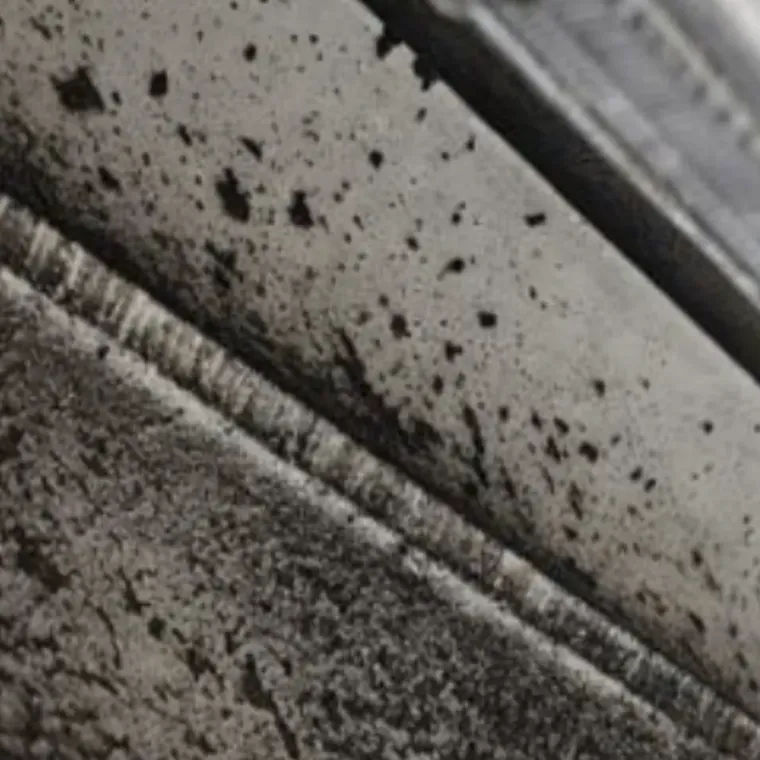
The photographs on the homepage are both of this. The coil pair and the blower pair are the same units before and after, and neither one had a filter problem.
The smell is the tell
If your mini-split gives off a musty, faintly sour smell for the first minute after it starts, that is not the room. That is a wet surface inside the unit with something growing on it, being blown at you.
It is most noticeable on start-up because the moisture sitting on the coil from the last cycle gets pushed into the room all at once. People often assume the smell is coming from somewhere else in the house precisely because it comes and goes with the machine.
Why the filter cannot fix this
Purely a matter of geometry. The coil sits behind the filters and the blower wheel sits behind the coil. Getting to either one means taking the cover off and protecting everything underneath, because whatever comes off has to go somewhere and it is directly above your floor and your furniture.
That is the whole reason mini-split cleaning is a separate job from filter maintenance rather than a thorough version of it. Nothing you can do from the front of the unit reaches the parts that are dirty.
When it is worth having done
I am not going to give you an interval, because the honest answer depends on how hard the unit works, whether there are pets, and whether it is in a kitchen. A guest room head that runs two months a year is not the same machine as the one in your main living space.
What I would look at instead:
- It smells on start-up. The most reliable single sign.
- Airflow has dropped. Same fan setting, less air arriving.
- It runs longer than it used to to hold the same temperature. A blocked coil cannot move heat, so the unit compensates with runtime, which you pay for.
- It has never been done and it is more than a few years old. These do not self-clean, and nothing in the normal owner’s routine reaches those parts.
If you are not sure, open the front and take a photograph looking down at the coil, then text it to me. That one picture answers the question most of the time.