
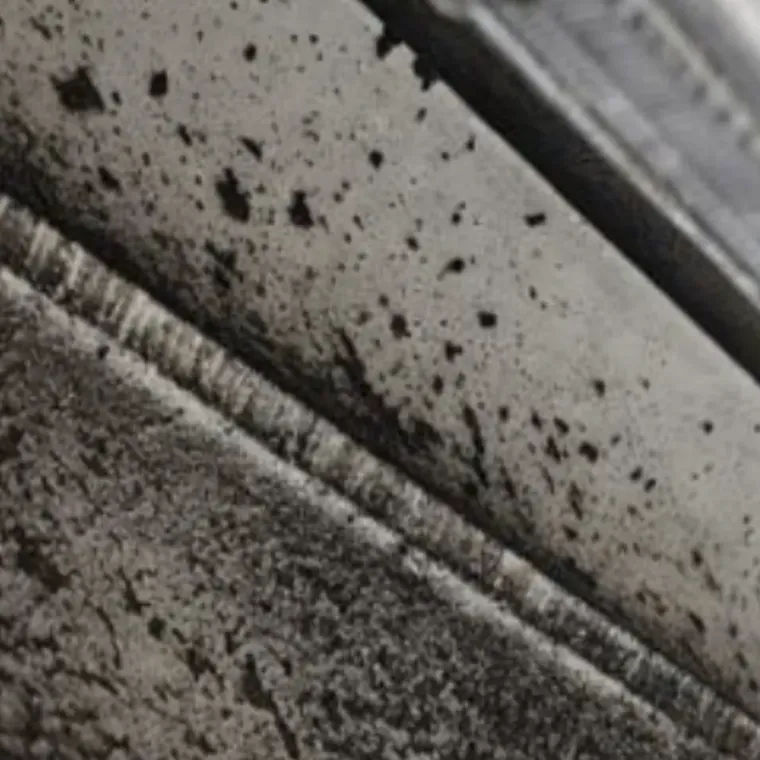
We live in a wet place, so this comes up constantly, and most of the photographs people send me are dust.
That is not me being dismissive. It is worth knowing, because “there is something dark inside my duct” and “there is mold in my house” are very different situations, and the second one is not fixed by cleaning.
Telling one from the other
Dust behaves predictably. It is even, it is grey or grey-brown, it settles on horizontal surfaces and not on the sides or the top of a duct, and it wipes off and stays off.
Growth does not behave like that. It is patchy rather than even. It turns up where moisture is rather than where gravity is, so it appears on vertical surfaces and undersides. It is often on something soft, insulation or duct board or a filter, rather than on bare sheet metal. And the thing that really separates it: cleaned off without dealing with why it was there, it comes back.
The part most people have backwards
Mold needs water. Not humidity in the abstract, actual liquid water or a surface staying damp for long enough.
Bare sheet metal duct running through a heated part of your house is usually a poor place for anything to grow. It is dry and the air moving through it is dry. That is why the inside of a supply run in a hallway ceiling is normally just dusty, no matter how old it is or how alarming the flashlight makes it look.
The places that actually stay wet are a short list:
- The evaporator coil. In cooling it runs below the dew point on purpose. It is wet for months of the year, which is the whole reason it has a drain.
- The drain pan and the drain line. Standing water by design, and a blocked line means standing water for longer than intended.
- The first stretch of duct downstream of the coil, which is where anything the coil throws off ends up.
- Duct running through an unconditioned crawlspace or attic. Warm moist air inside, cold surface outside, or the reverse in summer. Condensation forms on whichever side is below the dew point.
- Anywhere insulation has been wet. A roof leak, a plumbing leak, or a crawlspace with a moisture problem. Wet fiberglass stays wet for a long time.
Notice what those have in common. They are all places where water is either produced or condenses. If you find growth, it is almost certainly in one of them, and that tells you where to look next.
Why that matters more than the cleaning does
If there is genuine growth in a system, something is keeping a surface wet, and the cleaning does not change that. It resets the clock.
So the question I actually want answered on a job like this is not “how bad is it”, it is “where is the water coming from”. A blocked condensate drain, a crawlspace with no vapor barrier, an uninsulated run through a cold space, a leak somebody patched upstairs and forgot about. Fix that and the cleaning holds. Skip it and you will be looking at the same thing next year.
What is not my job
Two situations, and I would rather say so here than at your house.
Extensive growth on porous material is remediation, not cleaning. Fiberglass duct board, internally lined duct and soaked insulation cannot be cleaned to a state anyone should trust, because the material holds what is in it. That material gets removed and replaced, and that is a different trade.
And nobody can identify what is growing by looking at it, including me. If what is in your system is extensive or somebody in the house is genuinely unwell, that is a conversation for a professional who does that work, not a duct cleaner with an opinion. It is also worth knowing that identifying the species usually does not change what has to be done about it, which is why testing is often not the first step people assume it is.
The honest summary
Most of the time it is dust, cleaning is optional, and I will tell you that.
Sometimes it is growth, in which case the cleaning is the easy half and finding the moisture is the half that decides whether you do this again.
Occasionally it is neither of those and it belongs to somebody else, and you should want a duct cleaner who says so.
If you have found something and you are not sure which of the three you are looking at, photograph it and text it to me. It costs you nothing and it settles the question faster than a callout does. The general case of when a system is worth cleaning at all is here.